Portal:Asia


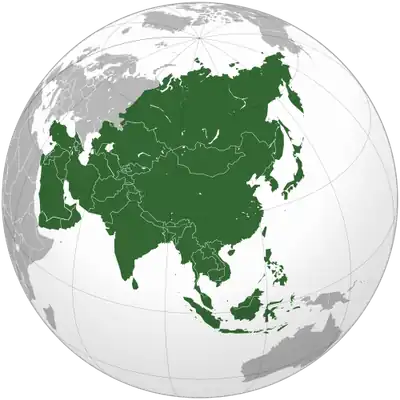 Asia (/ˈeɪʒə/ ⓘ AY-zhə, UK also /ˈeɪʃə/ AY-shə) is the largest continent in the world by both land area and population. It covers an area of more than 44 million square kilometres, about 30% of Earth's total land area and 8% of Earth's total surface area. The continent, which has long been home to the majority of the human population, was the site of many of the first civilisations. Its 4.7 billion people constitute roughly 60% of the world's population. Asia shares the landmass of Eurasia with Europe, and of Afro-Eurasia with both Europe and Africa. In general terms, it is bounded on the east by the Pacific Ocean, on the south by the Indian Ocean, and on the north by the Arctic Ocean. The border of Asia with Europe is a historical and cultural construct, as there is no clear physical and geographical separation between them. A commonly accepted division places Asia to the east of the Suez Canal separating it from Africa; and to the east of the Turkish straits, the Ural Mountains and Ural River, and to the south of the Caucasus Mountains and the Caspian and Black seas, separating it from Europe. Since the concept of Asia derives from the term for the eastern region from a European perspective, Asia is the remaining vast area of Eurasia minus Europe. Therefore, Asia is a region where various independent cultures coexist rather than sharing a single culture, and its boundary with Europe is somewhat arbitrary and has moved since its first conception in classical antiquity. The division of Eurasia into two continents reflects East–West cultural differences, some of which vary on a spectrum. (Full article...) Featured articleThe Song dynasty (/sʊŋ/ SUUNG) was an imperial dynasty of China that ruled from 960 to 1279. The dynasty was founded by Emperor Taizu of Song, who usurped the throne of the Later Zhou dynasty and went on to conquer the rest of the Ten Kingdoms, ending the Five Dynasties and Ten Kingdoms period. The Song often came into conflict with the contemporaneous Liao, Western Xia, and Jin dynasties in northern China. After retreating to southern China following attacks by the Jin dynasty, the Song was eventually conquered by the Mongol-led Yuan dynasty. The dynasty's history is divided into two periods: during the Northern Song (北宋; 960–1127), the capital was in the northern city of Bianjing (now Kaifeng) and the dynasty controlled most of what is now East China. The Southern Song (南宋; 1127–1279) comprised the period following the loss of control over the northern half of Song territory to the Jurchen-led Jin dynasty in the Jin–Song wars. At that time, the Song court retreated south of the Yangtze and established its capital at Lin'an (now Hangzhou). Although the Song dynasty had lost control of the traditional Chinese heartlands around the Yellow River, the Southern Song Empire contained a large population and productive agricultural land, sustaining a robust economy. In 1234, the Jin dynasty was conquered by the Mongols, who took control of northern China, maintaining uneasy relations with the Southern Song. Möngke Khan, the fourth Great Khan of the Mongol Empire, died in 1259 while besieging the mountain castle Diaoyucheng in Chongqing. His younger brother Kublai Khan was proclaimed the new Great Khan and in 1271 founded the Yuan dynasty. After two decades of sporadic warfare, Kublai Khan's armies conquered the Song dynasty in 1279 after defeating the Southern Song in the Battle of Yamen, and reunited China under the Yuan dynasty. (Full article...) Selected Country Saudi Arabia, officially the Kingdom of Saudi Arabia (KSA), is a country in West Asia. Located in the centre of the Middle East, it covers the bulk of the Arabian Peninsula and has a land area of about 2,150,000 km2 (830,000 sq mi), making it the fifth-largest country in Asia, the largest in the Middle East, and the twelfth-largest in the world. It is bordered by the Red Sea to the west; Jordan, Iraq, and Kuwait to the north; the Arabian Gulf, Bahrain, Qatar and the United Arab Emirates to the east; Oman to the southeast; and Yemen to the south. The Gulf of Aqaba in the northwest separates Saudi Arabia from Egypt and Israel. Saudi Arabia is the only country with a coastline along both the Red Sea and the Arabian Gulf, and most of its terrain consists of arid desert, lowland, steppe, and mountains. The capital and largest city is Riyadh; other major cities include Jeddah and the two holiest cities in Islam, Mecca and Medina. With a population of 33.7 million, Saudi Arabia is the sixth most populous country in the Arab world. Pre-Islamic Arabia, the territory that constitutes modern-day Saudi Arabia, was the site of several ancient cultures and civilizations; the archaeological study of the prehistory of Saudi Arabia has identified some of the earliest traces of human activity outside Africa. Islam emerged in what is now Saudi Arabia in the early seventh century. Islamic prophet Muhammad united the population of the Arabian Peninsula and created a single Islamic religious polity. Following his death in 632, his followers expanded Muslim rule beyond Arabia, conquering territories in North Africa, Central, South Asia and Iberia within decades. Arab dynasties originating from modern-day Saudi Arabia founded the Rashidun (632–661), Umayyad (661–750), Abbasid (750–1517), and Fatimid (909–1171) caliphates, as well as numerous other Muslim states in Asia, Africa, and Europe. (Full article...) Featured biographyAlbertus Soegijapranata SJ (Indonesian: [alˈbərtʊs suˈɡijapraˈnata]; Perfected Spelling: Albertus Sugiyapranata; 25 November 1896 – 22 July 1963), better known by his birth name Soegija, was a Jesuit priest who became the Apostolic Vicar of Semarang and later its archbishop. He was the first native Indonesian bishop and known for his pro-nationalistic stance, often expressed as "100% Catholic 100% Indonesian". Soegija was born in Surakarta, Dutch East Indies, to a Muslim courtier and his wife. The family moved to nearby Yogyakarta when Soegija was still young; there he began his education. Known as a bright child, around 1909 he was asked by Father Frans van Lith to enter Xaverius College, a Jesuit school in Muntilan, where Soegija slowly became interested in Catholicism. He was baptised on 24 December 1910. After graduating from Xaverius in 1915 and spending a year as a teacher there, Soegija spent two years at the on-site seminary before going to the Netherlands in 1919. He began his two-year novitiate with the Society of Jesus in September 1920 in Grave, and finished his juniorate there in 1923. After three years studying philosophy at Berchmann College in Oudenbosch, he was sent back to Muntilan as a teacher for a further two years. In 1928, he returned to the Netherlands to study theology at Maastricht, where he was ordained by Bishop of Roermond Laurentius Schrijnen on 15 August 1931; Soegija then added the word "pranata" to the back of his name. He was then sent back to the Indies to preach and became a parochial vicar at the parish in Kidul Loji, Yogyakarta, and in 1934 he was given his own parish in Bintaran. There he focused on creating a sense of Catholicism within the native community, emphasising the need for strong bonds between Catholic families. Soegijapranata was consecrated as the vicar apostolic of the newly established Apostolic Vicariate of Semarang in 1940. (Full article...) General imagesThe following are images from various Asia-related articles on Wikipedia.
Featured picture The earliest credible evidence of either coffee drinking or knowledge of the coffee tree appears in the late 15th century, by Sufi Imam Muhammad Ibn Said Al Dhabhani who is known to have imported goods from Ethiopia to Yemen. From the Arabian peninsula its use spread across the globe. The picture shows Palestinian women grinding coffee beans.
Did you know...
Updated: 1:05, 30 August 2026 In the news
Related portalsMajor Religions in Asia Middle East (West Asia) Central Asia Indian Subcontinent Southeast Asia East Asia Selected panorama
The night skyline of Hong Kong, Victoria Harbour and Kowloon, as seen from Victoria Peak, the tallest mountain on Hong Kong Island. Hong Kong is located on China's south coast on the Pearl River Delta, and borders Guangdong province in the north and faces the South China Sea in the east, west and south. It has a population of 6.9 million people, and is one of the most densely populated areas in the world. TopicsCategories Select [►] to view subcategories
Stone crosses in Asia Associated WikimediaThe following Wikimedia Foundation sister projects provide more on this subject:
More portalsDiscover Wikipedia using portals
Shortcuts to this page: Asia portal • P:ASIA |