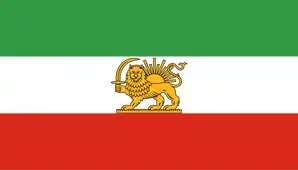
Iran has one of the oldest histories in the world, extending more than 5000 years, and throughout history, Iran has been of geostrategic importance because of its central location in Eurasia and Western Asia. Iran is a founding member of the UN, NAM, OIC, OPEC, and ECO. Iran as a major regional power occupies an important position in the world economy due to its substantial reserves of petroleum and natural gas, and has considerable regional influence in Western Asia. The name Iran is a cognate of Aryan and literally means "Land of the Aryans." (Full article...)
Recognised content -
Entries here consist of Good and Featured articles, which meet a core set of high editorial standards.
Before his accession to the throne, Bahram served as governor of the southeastern province of Kirman. There he bore the title of Kirmanshah (meaning "king of Kirman"), which would serve as the name city he later founded in western Iran. (Full article...)
Musa (also spelled Mousa), also known as Thea Musa, was the reigning queen of the Parthian Empire from 2 BC to 4 AD.
Originally an Italian slave-girl, Augustus gifted her to Phraates IV. She quickly became queen and a favourite of Phraates IV, giving birth to a son, Phraataces, who would later be known as Phraates V. In 2 BC, she had Phraates IV poisoned and made herself, along with Phraates V, the co-rulers of Parthia. Their reign was short-lived; they were forced to flee to Rome after being deposed by the Parthian nobility, who crowned Orodes III as king. (Full article...)
The son of the governor of Bust, Maymandi was raised as the foster brother of the Ghaznavid prince Mahmud, and would first start his administrative career as the head of the department of correspondences of Khorasan. He would thereafter rapidly rise to higher offices, finally becoming the vizier of the Ghaznavid dynasty in 1013, which would last until 1024, when he was arrested due to the great amount of wealth that he had gained, which the suspicious Mahmud disliked. (Full article...)
Image 4
Golden medallion of enthroned Sasanian style Adud al-Dawla Cast and chased in high relief, holding a goblet and surrounded by attendants, with lions beneath the throne.
Fannā (Panāh) Khusraw (Persian: پناه (فنا) خسرو), better known by his laqab of ʿAḍud al-Dawla (Arabic: عضد الدولة, lit.'pillar of the dynasty'; 24 September 936– 26 March 983) was an emir of the Buyid dynasty, ruling from 949 to 983. At the height of his power, he ruled an empire stretching from Makran to Yemen and the shores of the Mediterranean Sea. He is widely regarded as the greatest monarch of the Buyid dynasty, and by the end of his reign he was the most powerful ruler in the Middle East. (Full article...)
The Greco-Persian Wars, also called the Persian Wars, were a series of armed conflicts involving various Greek city-states and the Achaemenid Empire from 499 BC to 449 BC. The precipitating collision between the fractious political world of ancient Greece and the enormous empire of ancient Persia had begun when the Persian king Cyrus the Great conquered the Greek-inhabited region of Ionia in 547 BC. As they struggled to exert authority over the independent-minded Ionian cities, the Persians appointed Greek tyrants to rule each of them, though this would prove to be the source of much trouble for the Greeks and the Persians alike.
In 499 BC, the Greek tyrant Aristagoras of Miletus embarked on what would ultimately be a failed expedition to conquer Naxos with Persian support. Anticipating his dismissal, Aristagoras incited Greek city-states in Asia Minor to join him in deposing their Persian rulers, sparking the Ionian Revolt. Despite initially lacking support from mainland Greece, Aristagoras secured alliances with Athens and Eretria that helped him capture and raze Sardis in 498 BC. In response to the loss of his regional capital city, the Persian king Darius the Great vowed to exact revenge against the Athenians and the Eretrians. Both sides then effectively stalemated until 495 BC, but in 494 BC, the Persian army consolidated and launched a major assault at the heart of the Ionion Revolt in Miletus; Ionia suffered a decisive defeat in the Battle of Lade, which enabled the collapse of the rebellion over the course of the following year. (Full article...)
Yahballaha III (c. 1245–13 November 1317), known in earlier years as Rabban Marcos (or Markos) was Patriarch of the East from 1281 to 1317. As patriarch, Yahballaha headed the Church of the East during the severe persecutions under the reign of khans Ghazan and his successor Öljaitü. He acknowledged the primacy of the Pope and tried to form a church union, which was rejected by the traditionalist bishops of the Church of the East.
The province of Georgia (Persian: ولایت گرجستان, romanized:Velāyat-e Gorjestān) was a velayat (province) of Safavid Iran located in the area of present-day Georgia. The territory of the province was principally made up of the two subordinate eastern Georgian kingdoms of Kartli (Persian: کارتیل, romanized:Kartil) and Kakheti (Persian: کاخت, romanized:Kakhet) and, briefly, parts of the Samtskhe-Saatabago. The city of Tiflis (present-day Tbilisi) was its administrative center, the base of Safavid power in the province, and the seat of the rulers of Kartli. It also housed an important Safavid mint.
Safavid rule was mainly exercised through the approval or appointment of Georgian royals of the Bagrationi dynasty, at times converts to Shia Islam, as walis or khans. The eastern Georgian kingdoms had been subjected in the early 16th century, their rulers did not commonly convert. Tiflis was garrisoned by an Iranian force as early as IsmailI's reign, but relations between the Georgians and Safavids at the time mostly bore features of traditional vassalage. David XI (Daud Khan) was the first Safavid-appointed ruler, whose placement on the throne of Kartli in 1562 marked the start of nearly two and a half centuries of Iranian political control of eastern Georgia. During the same period, Iranian cultural influence dominated eastern Georgia. (Full article...)
Image 8
A map depicting the major areas of conflict during the Battle of Salamis
The Iranian Enlightenment (Persian: روشنگری ایرانی), sometimes called the first generation of intellectual movements in Iran (Persian: نسل اول جنبش های روشنفکری در ایران), brought new ideas into traditional Iranian society from the mid-19th to the early 20th centuries. During the Qajar era, and especially after Iran's defeat in the last Russo-Persian War (1826–1828), cultural exchanges led to the formation of new ideas among the educated class of Iran. The establishment of Dar al-Fonun, the first modern university in Iran and the arrival of foreign professors, caused the thoughts of European thinkers to enter Iran, followed by the first signs of enlightenment and intellectual movements in Iran.
By the late 11th century, the Shi'a sub-sect of Ismailism (later Nizari Ismailism) had found many adherents in Persia, although the region was occupied by the SunniSeljuk Empire. The hostile tendencies of the Abbasid–Seljuk order triggered a revolt by Ismailis in Persia under Hassan-i Sabbah, starting the so-called Alamut Period.
Due to the increasingly significant socio-economic issues, the decentralization of the Seljuk government leading to inefficient army mobilization, and a unifying factor of religion in the provinces facilitating the swift spread of the revolt and a strong sense of community within Isamilis, the Seljuks were unable to quickly put down the revolt. (Full article...)
Image 2
During the late 20th and early 21st centuries in Iran, women's rights have been severely restricted, compared with those in most developed nations. The World Economic Forum's 2017 Global Gender Gap Report ranked Iran 140, out of 144 countries, for gender parity. In 2017, in Iran, women comprised just 19% of the paid workforce, with seven percent growth since 1990. In 2017, the Georgetown Institute for Women, Peace and Security (WPS) Index ranked Iran in the bottom tercile of 153 countries. Compared to other South Asian regions, women in Iran have a better access to financial accounts, education, and mobile phones. Iran was ranked 116, out of the 153 countries, in terms of legal discrimination against women.
In Iran, women's rights have changed according to the form of government ruling the country, and attitudes towards women's rights to freedom and self-determination have changed frequently. With the rise of each government, a series of mandates for women's rights have affected a broad range of issues, from voting rights to dress code. (Full article...)
The office was established after the adoption of the new constitution following the Iranian Revolution of 1979. The first presidential election was held in 1980. The president is the second in command of the executive branch of government after the supreme leader, and chairperson of the cabinet, and is responsible for the day-to-day administration of the government. The president answers to the supreme leader and executes his decrees. The president appoints the ministers, subject to the approval of Parliament and the supreme leader, who can dismiss or reinstate any of the ministers and vice presidents at any time. The president issues decrees, sends and receives foreign ambassadors, signs referendum results and legislation approved by parliament and the judiciary, and signs treaties, protocols, contracts, after parliamentary approval. (Full article...)
In classical antiquity, part of the territory of present-day Tehran was occupied by Rhages, a prominent Iranian city that was not destroyed in the medieval Arab and Mongol invasions. Rey is absorbed into the metropolitan area of Greater Tehran. Tehran was first chosen as the capital of Iran in 1786 by Agha Mohammad Khan of the Qajar dynasty, because of its proximity to Iran's territories in the Caucasus—which were contested in the Russo-Iranian Wars—and to avoid the vying factions of prior ruling Iranian dynasties; the capital of Iran had been moved several times throughout its long history, with Tehran becoming the 51st. Under Reza Shah, Tehran witnessed Iran's first institute of higher learning, bank, railway line, and museum. Large-scale construction works began in the 1920s, and Tehran became a destination for mass migrations from all over Iran, especially in the 20th century. Tehran was at the center of the Iranian Revolution, and experienced major bombing damage during the Iran–Iraq War, the Twelve-Day War, and the 2026 Iran war. (Full article...)
Iran is home to one of the world's oldest continuous civilizations, with historical and urban settlements dating back to the 5th millennium BC. The Iranian plateau's western regions were home to the Elamites, Kassites, Gutians, Urartians, and the Mannaeans in Kurdistan. The Iranian empire began with the rise of the Medes during the Iron Age, when Iran was unified as a nation under the Median kingdom in the 7th century BC. By 550 BC, the Medes were sidelined by the conquests of Cyrus the Great, who brought the Persians to power with the establishment of the Achaemenid Empire. Cyrus' ensuing campaigns enabled the Persia's expansion across most of West Asia and much of Central Asia, and his successors would conquer parts of Southeast Europe and North Africa to preside over the largest empire yet seen. In the 4th century BC, the Achaemenid Empire was conquered by the Macedonian Empire of Alexander the Great, whose death led to the establishment of the Seleucid Empire over the bulk of former Achaemenid territory. In the following century, Greek rule of the Iranian plateau came to an end with the rise of the Parthian Empire, which conquered large parts of the Seleucids' Anatolian, Mesopotamian, and Central Asian holdings. While the Parthians were succeeded by the Sasanian Empire in the 2nd century, Iran remained a leading power for the next millennium, although most of this period was marked by the Roman–Persian Wars. (Full article...)
Image 7
The Republic of India and the Islamic Republic of Iran maintain a bilateral relationship. Independent India and Iran established diplomatic relations on 15 March 1950.
Contact between both ancient Persia and ancient India date to ancient times, and can be seen through the diffusion of Persian culture among Islamic culture in much of South Asia; furthermore, around 15% of the Muslims in India are Shia, a group Iran considers itself to represent on the world stage. Outside the Islamic community, the impact of Persian culture has primarily been in northwest India. (Full article...)
Image 8
The Sasanian Empire (/sə.ˈsɑː.ni.ən/), officially Eranshahr (Middle Persian: 𐭠𐭩𐭥𐭠𐭭𐭱𐭲𐭥𐭩, romanized:Ērānšahr, lit.'Empire of the Iranians'), was an Iranian empire that was founded and ruled by the House of Sasan from 224 to 651AD (the era of late antiquity). Lasting for over four centuries, the length of the Sasanian dynasty's reign over ancient Iran was second only to that of the Arsacid dynasty of Parthia which immediately preceded it. Founded by Ardashir I, whose rise coincided with the decline of Arsacid influence in the face of both internal and external strife, the House of Sasan was highly determined to restore the legacy of the Achaemenid Empire by expanding and consolidating the dominions of the Iranian nation. Most notably, after defeating Artabanus IV of Parthia at the Battle of Hormozdgan in 224, it began competing far more zealously with the neighboring Roman Empire than the Arsacids had, thus sparking a new phase of the Roman–Iranian Wars. These efforts by Sasanian rulers ultimately led to the re-establishment of Iran as a major power of late antiquity. (Full article...)
... that after Jamal Valizadeh was tortured in Iran, hid for six months, and escaped, he qualified to compete in the Olympics as a member of the Refugee Olympic Team?
... that shortly after the publication of Women Without Men in Iran, it was banned and its author imprisoned?
... that Trump wrote a letter to Ali Khamenei in an effort to initiate new nuclear negotiations with Iran?
This is a list of recognized content, updated weekly by JL-Bot (talk·contribs) (typically on Saturdays). There is no need to edit the list yourself. If an article is missing from the list, make sure it is tagged(e.g. {{WikiProject Iran}})or categorized correctly and wait for the next update. See WP:RECOG for configuration options.
Persian cinema • Persian literature • Zoroastrianism
Related projects
Geography • History • Armenia • Azerbaijan • Caucasia • Central Asia • Iraq • Russia • Georgia • Islam • Kurdistan • Afghanistan • Turkmenistan • Tajikistan • Greece • Turkey
You are invited to participate in WikiProject Iran, a WikiProject dedicated to developing and improving articles about Iran.
~~~~
Things you can do
Things you can do
Requested articles: House of Dahae, House of Parni, House of Sohae, Amards civilization, Iranian / Persian Cuisine / Cooking / Food, Anjoman e Payvand, More...