UNION OF SOVIET SOCIALIST REPUBLICS
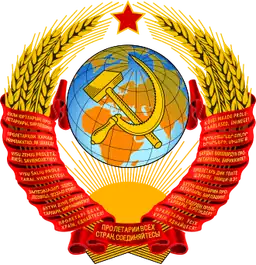
Coat of arms of the Soviet Union 1
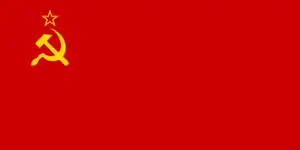
The flag of the Soviet Union The
Soviet Union , officially the
Union of Soviet Socialist Republics (
USSR ), was a
transcontinental country that spanned much of
Eurasia from its formation in 1922 until
its dissolution in 1991. It was the world's
third-most populous country , the
largest by area , and
bordered twelve other countries . A diverse
multinational state , it was organized as a
federal union of
national republics , with the largest and most populous being the
Russian Soviet Federative Socialist Republic (SFSR). The world's flagship
communist state , it was governed by the
Communist Party under
Marxism–Leninism , through
soviet councils . The
Soviet economy was also
centrally planned . Its capital and largest city was
Moscow .
The Soviet Union's roots lay in the October Revolution of 1917. The new government, led by Vladimir Lenin , established the Russian SFSR, the world's first constitutionally communist state . Following the Bolshevik victory in the Russian Civil War , the Russian SFSR and its subordinate republics were merged into the Soviet Union in 1922. Following Lenin's death in 1924, a six-year power struggle saw Joseph Stalin emerge as the country's undisputed personalist ruler. He initiated rapid industrialization and forced collectivization that led to significant growth, but contributed to a devastating famine in the 1930s that killed millions. The Soviet forced labour camp system, known as the Gulag , was expanded. During the late 1930s, Stalin's government conducted the Great Purge to eliminate opposition, resulting in deportations , executions , and the Moscow trials . Failing to build an anti-Nazi coalition in Europe, the Soviet Union signed a non-aggression pact with Nazi Germany in 1939. However, in 1941, Germany invaded the Soviet Union in the largest land invasion in history, opening the Eastern Front of World War II . The Soviet Union played a decisive role in defeating the Axis powers as part of the Allies , while extending its sphere of influence to Central and Eastern Europe . With around 27 million casualties , it suffered the most deaths of any country in World War II . In the war's aftermath , the Soviet Union consolidated the territories occupied by the Red Army into satellite states and undertook rapid economic development , cementing its status as a superpower .
Geopolitical tensions with the United States led to the Cold War . The US-led Western Bloc coalesced into the NATO military alliance in 1949, prompting the Eastern Bloc to form the Warsaw Pact in 1955. With little direct combat , the blocs engaged in ideological and proxy wars . In 1953, following Stalin's death , Nikita Khrushchev initiated a campaign of de-Stalinization , which led to ideological tensions with communist China , under Mao Zedong , and culminated in an acrimonious split . The Soviet military suppressed uprisings in East Germany , Hungary and Czechoslovakia , while the resolution of the Cuban Missile Crisis narrowly averted a global conflict . Under Leonid Brezhnev , prosperity shifted toward stagnation , although relations with the US eased . In 1985, Mikhail Gorbachev sought reform through his policies of glasnost perestroika overthrew their Soviet-backed regimes , effectively ending the Eastern Bloc. Nationalist movements across the Soviet republics declared sovereignty , and in 1991, a successful referendum to establish a renewed federation was followed by a failed coup by hardliners . This prompted Russia, Ukraine, and Belarus to secede . On 26 December, Gorbachev officially recognized the dissolution of the Soviet Union. Boris Yeltsin , president of the Russian SFSR, oversaw its reconstitution into the Russian Federation , the Soviet Union's successor state . All fifteen republics became independent states ; all except the Baltic states joined the Commonwealth of Independent States . The post-Soviet states experienced a humanitarian disaster .
The Soviet Union was one of the world's two superpowers, with
hegemony in Eastern Europe ,
global diplomacy , ideological influence (particularly in the
Global South ), military might, economic strength, and
scientific and technological accomplishments .
Its space program made
significant achievements in the
Space Race . It
had the world's second-largest economy and the largest
standing military . As a
nuclear state , it wielded the
largest arsenal of nuclear weapons in the world . As an Allied nation, it was a
founding member of the
United Nations and one of
five permanent members of its
Security Council . (
Full article... )
Entries here consist of Good and Featured articles, which meet a core set of high editorial standards.
Mir Russian : Мир , IPA: [ ˈmʲir] lit. ' peace ' or ' world ' ) was a space station operated in low Earth orbit from 1986 to 2001, first by the Soviet Union and later by the Russian Federation . Mir was the first modular space station and was assembled in orbit from 1986 to 1996. At the time it was the largest artificial satellite in orbit, only being succeeded by the International Space Station (ISS) after Mir 's deorbitingmicrogravity research laboratory in which crews conducted experiments in biology , human biology , physics, astronomy , meteorology , and spacecraft systems with a goal of developing technologies required for permanent occupation of space .
Mir was the first continuously inhabited long-term research station in orbit and previously held the record for the longest continuous human presence in space at 3,644 days, until it was surpassed by the ISS in 2010. It holds the record for the longest single human spaceflight, Valeri Polyakov , who spent 437 days on the station from 1994 until 1995. Mir's typical crew size was 3, though larger short-term crews made an appearance, peaking at ten during STS-71 . Occupied for twelve and a half years out of its fifteen-year lifespan, 105 cosmonauts and astronauts from 12 different nations visited the station, and conducted 80 spacewalks . (Full article...
... that because Leonid Brezhnev had more than 200 decorations, it was decided to break the Soviet custom of featuring only one decoration on cushions during his funeral
What are WikiProjects ?
Andrei Pavlovich Kirilenko Ukrainian : Андрій Павлович Кириленко , romanized : Andriy Pavlovych Kyrylenko Russian : Андрей Павлович Кириленко , IPA: [ ɐnˈdrʲej ˈpavləvʲɪtɕ kʲɪrʲɪˈlʲɛnkə] [ O.S. 26 August] 1906 – 12 May 1990) was a Soviet politician, and a member of the Secretariat of the Communist Party of the Soviet Union . He was one of the most loyal politicians to Leonid Brezhnev .
His role in the CPSU was to ensure Brezhnev's power base and, if possible, to strengthen Brezhnev's position within the party. In order to accomplish this task, he emerged as one of the leading figures in the Secretariat under Brezhnev's rule. (Full article...
The following are images from various Soviet Union-related articles on Wikipedia.
Image 1 The
Russian famine of 1921–22 killed an estimated 5 million people.
(from
History of the Soviet Union )
Image 5 A poster depicting the effect of the Revolution on the life of a peasant, 1920. From the collections of
RGASPI (from
Russian Revolution )
Image 6 European theatre of the
Russian Civil War in 1918 (from
October Revolution )
Image 7 Stalin and
Lavrentiy Beria with Stalin's daughter,
Svetlana , on his lap. As head of the NKVD, Beria was responsible for many
political repressions in the Soviet Union . (from
History of the Soviet Union )
Image 8 A revolutionary meeting of Russian soldiers in March 1917 in Dalkarby of
Jomala ,
Åland (from
Russian Revolution )
Image 9 Lenin ,
Trotsky , and
Kamenev celebrating the second anniversary of the
October Revolution (from
History of the Soviet Union )
Image 10 The elections to the
Constituent Assembly took place in November 1917. The Bolsheviks won 24% of the vote. (from
October Revolution )
Image 12 Red Guard unit of the Vulkan factory in Petrograd, October 1917 (from
October Revolution )
Image 13 Revolutionaries attacking the tsarist police in the early days of the February Revolution (from
Russian Revolution )
Image 14 Forward gun of
Aurora that fired the signal shot (from
October Revolution )
Image 15 Anniversary of October Revolution in
Riga , Soviet Union in 1988 (from
October Revolution )
Image 17 Russian troops in trenches awaiting a German attack (from
Russian Revolution )
Image 19 Soldiers marching in
Petrograd , March 1917 (from
Russian Revolution )
Image 20 Soviet leader
Nikita Khrushchev (left) with US President
John F. Kennedy in Vienna, 3 June 1961 (from
History of the Soviet Union )
Image 21 The 2nd Moscow Women Death Battalion protecting the Winter Palace as the last guards of the stronghold (from
Russian Revolution )
Image 23 The
Pan-European Picnic took place in August 1989 on the Hungarian-Austrian border. (from
History of the Soviet Union )
Image 24 Bolshevik (1920) by
Boris Kustodiev (from
October Revolution )
Image 25 Lenin ,
Trotsky and
Kamenev celebrating the second anniversary of the October Revolution (from
October Revolution )
Image 26 Map showing the greatest territorial extent of the Soviet Union and the sovereign states that it dominated politically, economically and militarily in 1960, after the
Cuban Revolution of 1959 but before the official
Sino-Soviet split of 1961 (total area: c. 35,000,000 km
2 ) (from
History of the Soviet Union )
Image 27 Petrograd
Milrevcom proclamation about the deposing of the
Russian Provisional Government (from
October Revolution )
Image 28 Country emblems of the Soviet Republics before and after the dissolution of the Soviet Union (the
Transcaucasian Socialist Federative Soviet Republic (fifth in the second row) no longer exists as a political entity of any kind and the emblem is unofficial.) (from
History of the Soviet Union )
Image 29 Russian troops meeting German troops in No Man's Land (from
Russian Revolution )
Image 30 Murder of the Romanov family,
Le Petit Journal (from
Russian Revolution )
Image 31 A scene from the July Days. The army has just opened fire on street protesters. (from
October Revolution )
Image 32 From left to right, the Soviet General Secretary
Joseph Stalin , US President
Franklin D. Roosevelt and British Prime Minister
Winston Churchill confer in Tehran, 1943 (from
History of the Soviet Union )
Image 33 Residents of Leningrad leave their homes destroyed by German bombing. About 1 million civilians died during the 871-day
Siege of Leningrad , mostly from starvation. (from
History of the Soviet Union )
Image 34 The
Battle of Stalingrad , considered by many historians as a decisive turning point of World War II (from
History of the Soviet Union )
Image 35 A detachment of Red Guard sailors who dissolved the Constituent Assembly (from
Russian Revolution )
Image 36 Soviet general secretary
Leonid Brezhnev and US President
Jimmy Carter sign the
SALT II arms limitation treaty in Vienna on 18 June 1979. (from
History of the Soviet Union )
Image 37 A detachment of Red Guard sailors who dissolved the Constituent Assembly (from
October Revolution )
Image 38 "Pogrom in the Winter Palace" by
Ivan Vladimirov (from
October Revolution )
Image 39 Meeting before the Russian wire entanglements (from
Russian Revolution )
Image 40 Changes in national boundaries after the end of the Cold War (from
History of the Soviet Union )
Image 41 American, British, and Japanese Troops parade through Vladivostok in armed support to the White Army. (from
Russian Revolution )
Image 42 Mikhail Gorbachev in one-to-one discussions with US President
Ronald Reagan (
left ), 1985 (from
History of the Soviet Union )
Image 43 Provisional Government 's volunteer soldiers secure Petrograd's
Palace Square with the
Austin Armoured Car , summer 1917. (from
Russian Revolution )
Image 44 Internally displaced Azerbaijanis from
Nagorno-Karabakh , 1993 (from
History of the Soviet Union )
Image 45 On 21 December 1991, the leaders of 11 former Soviet republics, including Russia and Ukraine, agreed to the
Alma-Ata Protocols , formally establishing the
Commonwealth of Independent States (CIS). (from
History of the Soviet Union )
Image 46 The New York Times headline from 9 November 1917 (from
October Revolution )
Image 47 Russian Civil War in the European part of Russia (from
History of the Soviet Union )
Image 48 Revolutionaries protesting in February 1917 (from
Russian Revolution )
August coup attempt Mikhail Gorbachev .
This is a list of recognized content, updated weekly by JL-Bot (talk · contribs) (typically on Saturdays). There is no need to edit the list yourself. If an article is missing from the list, make sure it is tagged (e.g. { { } } or categorized correctly and wait for the next update. See WP:RECOG for configuration options.
2020-09-16 165855 Soviet submarine B-515
Alexei Leonov
Field Marshal Keitel signs German surrender terms in Berlin 8 May 1945 - Restoration
German instrument of surrender2
Instrument of surrender Japan2
Mamoru Shigemitsu signs the Instrument of Surrender, officially ending the Second World War
Maxim Gorky LOC Restored edit1
Moscow Elektrozavodskaya metro station asv2018-09
Prokofieff (i.e. Prokofiev) LCCN2014708419 Crop 2
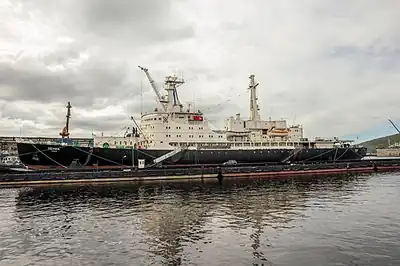
RUS-2016-Murmansk-Icebreaker Lenin 01
Raising a flag over the Reichstag - Restoration
Russian Imperial Family 1913
USS Yorktown collision
Yalta Conference (Churchill, Roosevelt, Stalin) (B&W)
Yuri Gagarin (1961) - Restoration
Yury Pen - Portrait of Marc Chagall
Did you know? articles
Main page featured articles
German instrument of surrender2 (2009-05-07)
Instrument of surrender Japan2 (2009-09-02)
Yalta Conference (Churchill, Roosevelt, Stalin) (B&W) (2010-05-08)
USS Yorktown collision (2011-02-12)
Maxim Gorky LOC Restored edit1 (2013-03-28)
Yuri Gagarin (1961) - Restoration (2020-03-09)
Alexei Leonov (2020-03-18)
Field Marshal Keitel signs German surrender terms in Berlin 8 May 1945 - Restoration (2020-05-08)
RUS-2016-Murmansk-Icebreaker Lenin 01 (2020-06-08)
Moscow Elektrozavodskaya metro station asv2018-09 (2022-02-26)
Russian Imperial Family 1913 (2022-07-17)
Mamoru Shigemitsu signs the Instrument of Surrender, officially ending the Second World War (2022-09-02)
2020-09-16 165855 Soviet submarine B-515 (2023-04-18)
Prokofieff (i.e. Prokofiev) LCCN2014708419 Crop 2 (2023-07-25)
Raising a flag over the Reichstag - Restoration (2025-05-02)
Main topics
Category puzzle Select [►] to view subcategories
Привет Wikipedia is the encyclopedia that anyone can edit. If you are interested in the Soviet Union and have some information that can be added to an existing article, please help. Here are some things you can do:
Deletion sorting : WikiProject Deletion sorting/RussiaNotability : articles with notability concerns, listed at WikiProject NotabilityRate : the Unassessed Soviet Union articles in the Soviet Union WikiProjectRequested articles : See the list of Missing articlesRequested images :Stubs: Soviet Union stubs Add {{Portal|Soviet Union}} to the See also section of Soviet-related articles
Tag the talk pages of Soviet-related articles with the { { } }
The following Wikimedia Foundation sister projects provide more on this subject:
WikiProject Russia
General: Portals: Tools: Task forces
Demographics and ethnography (PP)
Economy (PP)
History (PP)
Human geography (PP)
Language and literature (PP)
Mass media (PP)
Military (PP)
Performing arts (PP)
Physical geography (PP)
Politics and law (PP)
Religion (PP)
Science and education (PP)
Sports and games (PP)
Technology and engineering (PP)
Visual arts (PP) Task forces Related projects:
Ossetia
Soviet Union
Soviet and post-Soviet cinema
Soviet and post-Soviet metros Project-specific guidelines:
General guidelines (draft)
Naming conventions (draft)
Romanization
Geographic naming conventions
Discover Wikipedia using portals
List of all portals
Random portal
WikiProject Portals